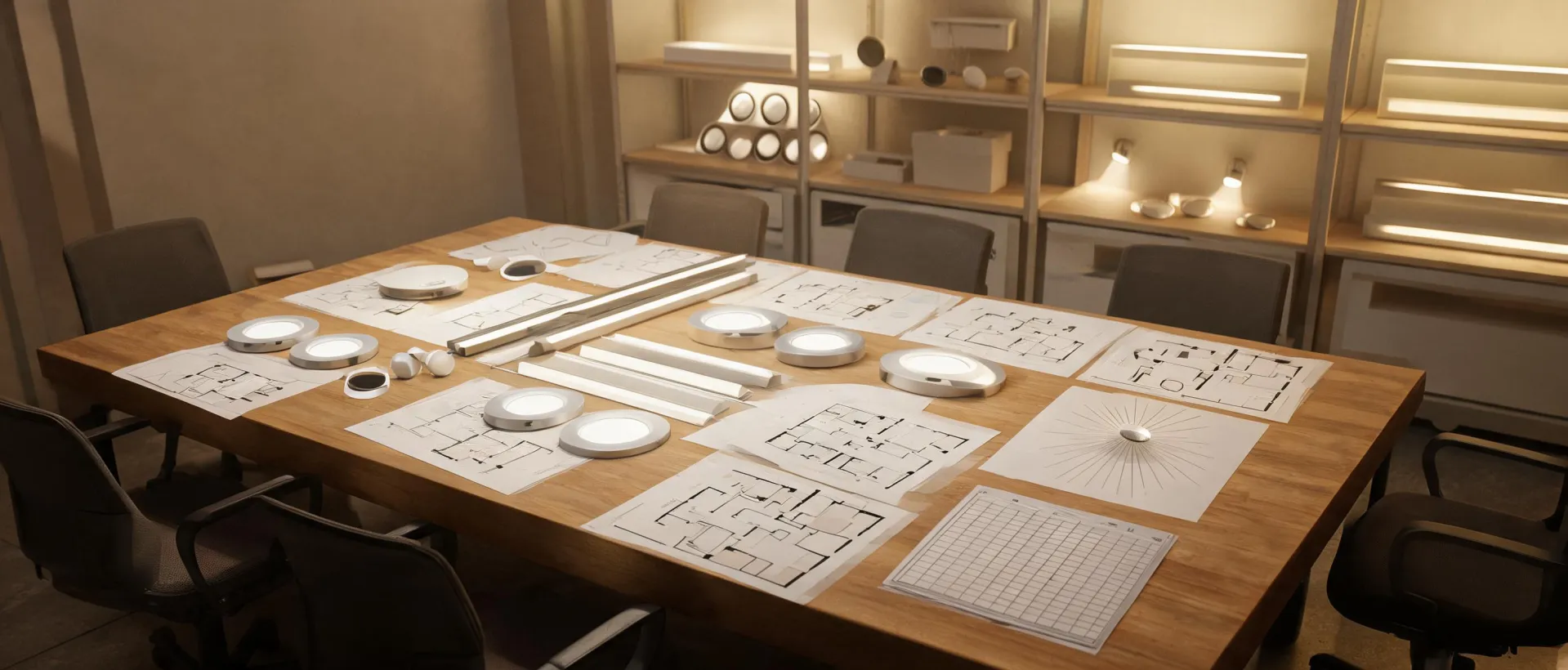
Lighting samples and room plans arranged for selection

Lighting Guide

Musco helps you choose by space, task, and budget

This guide is a conversation map: define what people need to see, identify physical and electrical constraints, then compare optical quality, controls, serviceability, and total project effort.

Do not begin with a fixture shape. Begin with the room, the task plane, the people looking through it, the hours of operation, and the team responsible for installation and upkeep. A clear brief narrows the product field faster than a long catalogue.

Three decisions that organize the shortlist

SPACE

Map the physical conditions

Record dimensions, mounting height, ceiling system, surface reflectance, ambient temperature, moisture or dust exposure, daylight openings, and maintenance access. For outdoor work, add pole locations, property boundaries, traffic or pedestrian routes, and spill-sensitive neighbors.

TASK

Name the visual job

Define the maintained illuminance plane, uniformity need, vertical visibility, color quality, glare sensitivity, camera requirement, and operating schedule. An office screen, warehouse rack, roadway conflict point, and playing surface each ask the optic to solve a different problem.

BUDGET

Count system effort, not unit price

Compare fixture quantity, mounting hardware, branch circuits, controls, programming, access equipment, energy, expected component service, and spare strategy. Integrated construction may reduce size and interfaces; replaceable drivers or light engines may improve long-term serviceability.

A selection path you can pause and verify

1Brief completed

List required criteria and identify preferences that may be traded.

2Photometric evidence reviewed

Use the correct IES/LDT revision with documented geometry, reflectance, light-loss factor, and calculation grid.

3Mock-up or sample checked

Inspect construction and service access; where risk warrants it, measure a representative installation at agreed points.

4Controls coordinated

Confirm whether 0-10V dimming, DALI-2, sensors, gateways, emergency behavior, and commissioning ownership are compatible.

Read credentials in their proper scope

UL

A North American safety certification reference must be verified for the specific product and listing; it does not establish photometric performance.

CE

CE marking relates to applicable European requirements and declared conformity. Confirm the covered model and documentation for the destination market.

RoHS

RoHS addresses restricted substances in applicable electrical and electronic equipment. It is not an energy-efficiency or lifetime rating.

Two common trade-offs

Maximum efficacy or visual comfort? Higher lm/W can reduce power, while optical control, UGR, CRI, and useful vertical light may justify a different balance. Centralized or distributed controls? Central management simplifies portfolio-wide policy, while distributed zoning can improve local flexibility and fault isolation. Neither choice is universally correct; building scale, network support, commissioning skill, and maintenance ownership decide the fit.

Limits remain: photometric predictions depend on accurate inputs; CCT and CRI do not fully describe perceived color; L70 is a lumen-maintenance projection rather than complete system-life assurance; wireless controls depend on site conditions; and product performance may require derating at high ambient temperature.
Build a shortlist with a Musco lighting advisor

Send your application, drawings, target criteria, preferred control method, and budget stage. We will help identify the next evidence to request.