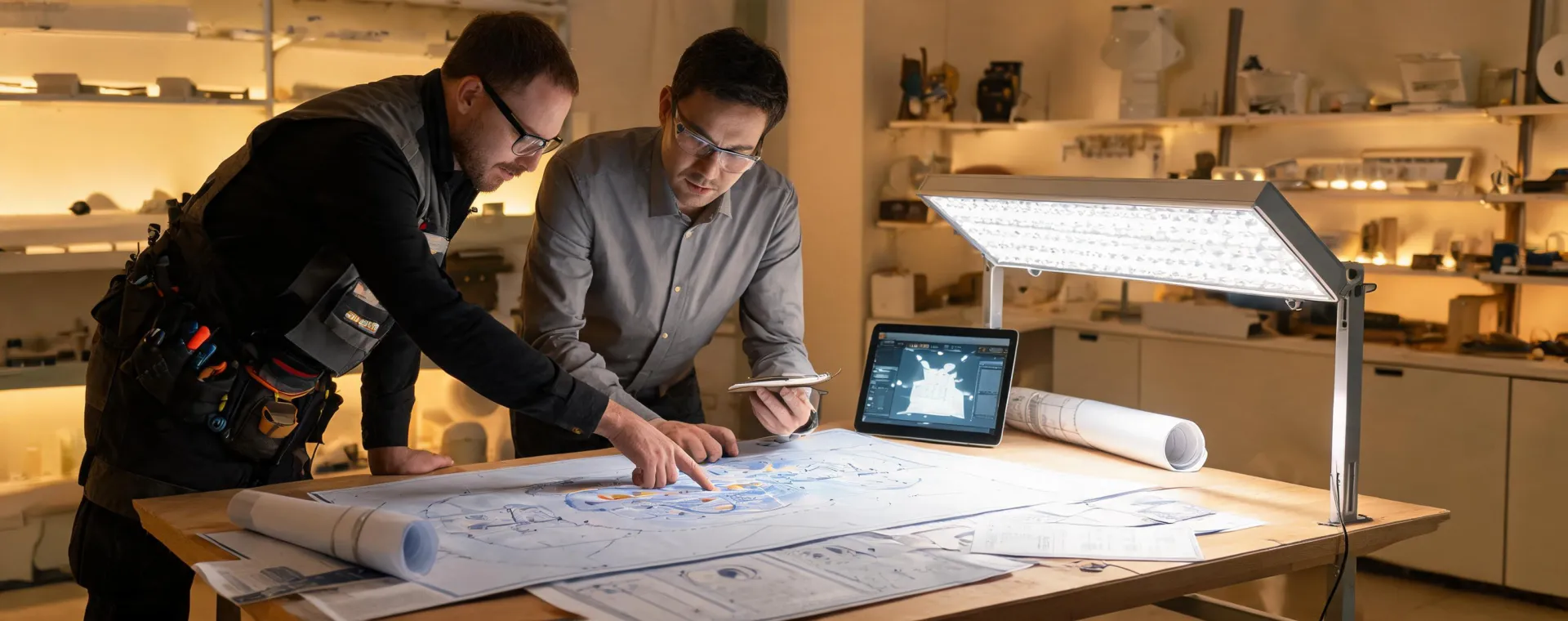
Lighting engineer reviewing photometric plans

Musco services keep lighting decisions connected

From early application questions to handover documents, the work is organized around decisions that designers, contractors, procurement teams, and facility operators can review together.

Three practical service tracks

01

Application review

We translate room dimensions, mounting height, reflectance assumptions, task locations, and operating hours into a clear photometric brief. The review identifies whether illuminance, uniformity, vertical light, glare, or spill control should govern selection. When source files are available, IES or LDT data can be organized for calculation rather than inferred from catalogue claims.

02

Specification coordination

Submittal support aligns luminous flux, CCT, CRI, IP rating, driver interfaces, and surge protection with the project schedule. UL, CE, and RoHS references are treated as product- and geography-specific checkpoints, not interchangeable badges. Open questions are recorded so an electrical engineer can close them before procurement.

03

Installation and handover

Contractor-facing notes cover aiming references, circuit grouping, sensor intent, and commissioning responsibilities. A handover package may include fixture schedules, control zoning, maintenance access notes, and final settings. Actual field verification remains necessary because surface finishes, obstructions, voltage conditions, and installation tolerances can change results.

A numbered path from question to handover

1

Frame

Confirm use, users, dimensions, budget boundary, and approval path.

2

Model

Test distribution and mounting assumptions with appropriate photometric data.

3

Coordinate

Check electrical, controls, structural, and access interfaces.

4

Verify

Compare approved documentation with installed conditions and commissioning records.

For repeatable review, record calculation software and version, room geometry, reflectance values, calculation grid, light-loss factor, luminaire file revision, and aiming. A sample bay or representative mock-up can then be measured at the same grid points. Results outside the agreed tolerance trigger an assumption review before fixture quantity is changed.

Clear boundaries make project support more useful

Photometric calculations predict performance from stated inputs; they do not replace field measurements. Published L70 lifetime is a lumen-maintenance projection, not a promise that every driver or control will operate for the same duration. Wireless coverage depends on building materials and network design, while high ambient temperatures may require derating. These constraints are documented early so a team can plan validation, spares, access, and commissioning without surprises.

Send a project brief for an application review

Share drawings, mounting heights, target criteria, control preferences, and the stage of your project. We will help structure the next technical conversation.